
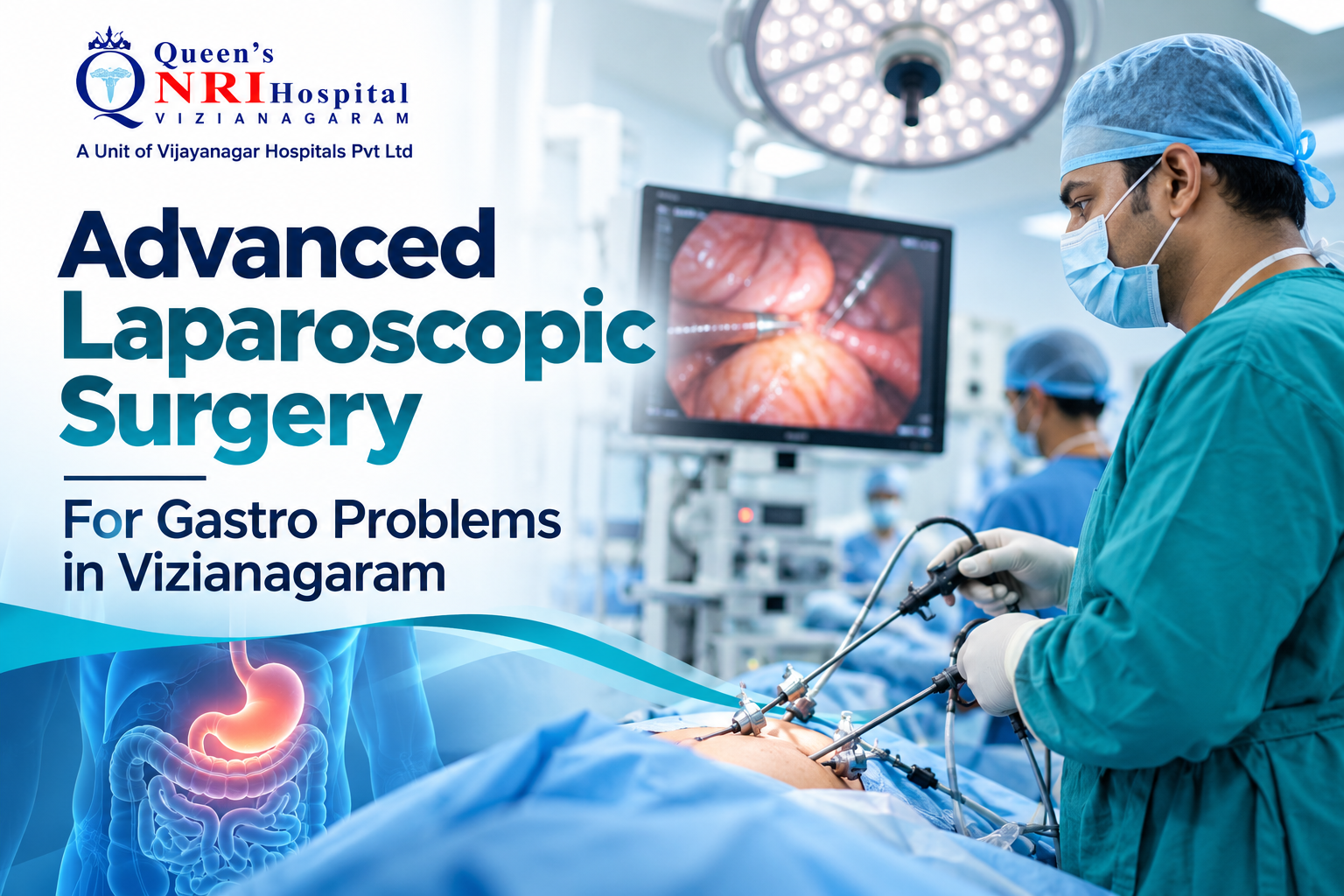
Advanced Laparoscopic Surgery for Gastro Problems in Vizianagaram
If you or a family member has been told that surgery is needed for a stomach, gallbladder, intestinal or liver-related problem, it is natural to feel worried. Many people still imagine a large cut, a long hospital stay and weeks of painful recovery. Modern medicine has changed this picture. Today, many digestive conditions can be treated through a few tiny incisions using laparoscopic, or “keyhole,” surgery.
If you are searching for the best gastroenterology hospital in Vizianagaram, understanding how laparoscopic surgery works, which conditions it treats and what to expect can help you decide with confidence. At Queen’s NRI Hospital, our Gastroenterology department works closely with surgical teams so that diagnosis, medical treatment and surgery are planned together for each patient.
This guide explains laparoscopic surgery for gastro problems in simple language, so you know what to ask your doctor and what to expect at each stage.
What Is Laparoscopic Surgery?
Laparoscopic surgery is a minimally invasive technique. Instead of one long incision on the abdomen, the surgeon makes several small cuts, usually between half a centimetre and one and a half centimetres long. Through one of them, a thin tube with a high-definition camera, called a laparoscope, is inserted. The camera sends a magnified view of the inside of the abdomen to a monitor in the operating theatre.
Through the other small openings, the surgeon passes slim, specially designed instruments. The abdomen is gently inflated with carbon dioxide gas to create working space and a clear view. The surgeon then performs the procedure by watching the screen, guided by a magnified, detailed view of the organs.
Because the muscles and tissues are disturbed far less than in open surgery, most patients experience less pain, smaller scars and a faster return to routine life.
Why the Right Hospital Matters for Laparoscopic Gastro Surgery
Laparoscopic surgery is only as safe as the team and technology behind it. A hospital that is truly suited for digestive surgery needs more than a surgeon. It needs:
- Experienced gastroenterologists and surgeons who work as a team
- High-definition laparoscopic equipment
- Endoscopy facilities for diagnosis and, where needed, treatment
- Reliable imaging such as ultrasound and CT
- A round-the-clock laboratory, pharmacy and emergency service
- Trained anaesthesia and critical care support
- Nutrition and physiotherapy support after surgery
These are the points to check when you compare hospitals. They are also the reasons many families in and around Vizianagaram look to Queen’s NRI Hospital when they need dependable digestive care close to home. With advanced laparoscopic equipment, endoscopy services and our Gastrointestinal Surgery department, backed by 24x7 emergency care, we aim to provide complete care under one roof.
Gastro Problems That Can Be Treated With Laparoscopic Surgery
Not every digestive condition needs surgery, and many are managed well with medicines, diet and lifestyle changes. But when surgery is advised, laparoscopy is often the preferred approach. Here are the common conditions where it is used.
1. Gallstones and Gallbladder Disease
Gallstones are one of the most common reasons for abdominal surgery. They can cause pain in the upper right abdomen, nausea, vomiting, bloating after fatty meals and, in some cases, jaundice or infection of the gallbladder.
Laparoscopic cholecystectomy, which means removal of the gallbladder through keyhole incisions, is the standard treatment for symptomatic gallstones. The gallbladder is a storage organ, and people live normally without it. Many patients go home within a day or two and return to light activity within a short period.
2. Appendicitis
Appendicitis causes pain that often starts near the navel and shifts to the lower right abdomen, along with fever, nausea and loss of appetite. It needs prompt attention, because a delay can lead to rupture of the appendix and serious infection.
Laparoscopic appendectomy allows the surgeon to remove the inflamed appendix through small incisions. It also gives a clear view of the rest of the abdomen, which helps when the diagnosis is not obvious.
3. Hernias
A hernia occurs when an organ or tissue pushes through a weak area in the abdominal wall. Inguinal (groin), umbilical, incisional and hiatal hernias are common. A hernia does not heal on its own, and it can become painful or dangerous if the trapped tissue loses its blood supply.
Laparoscopic hernia repair places a mesh to reinforce the weak area, often with less post-operative pain and a quicker return to work than traditional repair. Our General and Laparoscopic Surgery team also performs gallbladder removal and appendectomy using modern laparoscopic equipment. The best technique depends on the type and size of the hernia, so the surgeon will advise what suits you.
4. Acid Reflux (GERD) and Hiatal Hernia
Most people with acid reflux improve with medicines and lifestyle changes. However, some continue to have severe heartburn, regurgitation or complications despite long-term treatment. In selected patients, laparoscopic anti-reflux surgery, known as fundoplication, strengthens the valve between the food pipe and the stomach and can reduce the need for lifelong medication. A proper work-up with endoscopy and other tests is done before this decision.
5. Intestinal Obstruction, Perforation and Adhesions
Blockages or perforations in the intestine can be life-threatening and often need urgent care. Depending on the patient’s condition, laparoscopy may be used to find the cause, release adhesions (bands of scar tissue) or repair a perforation. In some emergencies, the surgeon may need to convert to open surgery for safety, and that decision always puts the patient first.
6. Colorectal and Bowel Conditions
Certain diseases of the large intestine, such as complicated diverticular disease, some benign growths and selected cases of bowel disease or tumours, can be treated with laparoscopic bowel resection. The diseased segment is removed and the healthy ends are joined. Suitability depends on the condition, its stage and the patient’s overall health.
7. Piles, Fissures and Anorectal Problems
Many anorectal conditions are treated with minimally invasive or day-care techniques. Early consultation helps, since it can avoid more complex surgery later.
8. Diagnostic Laparoscopy
When scans and tests cannot explain persistent abdominal pain or a suspicious finding, diagnostic laparoscopy lets the surgeon look directly inside the abdomen and, if needed, take a small tissue sample (biopsy) in the same sitting.
Benefits of Laparoscopic Surgery for Digestive Problems
Compared with open surgery, laparoscopy offers several advantages for suitable patients:
- Smaller incisions and minimal scarring. Cosmetic results are better, and wound-related problems are fewer.
- Less pain after surgery. Patients often need fewer painkillers.
- Shorter hospital stay. Many procedures need only one to three days in hospital.
- Quicker recovery. Walking, eating and returning to routine activity usually happen sooner.
- Lower risk of wound infection and hernia at the incision site.
- Magnified, clear view of the organs, which supports precise surgery.
Every patient is different, and the benefits depend on the condition, the stage of disease and general health.
How the Team Approach Works at Queen’s NRI Hospital
Digestive problems rarely fit into one box. A patient with upper abdominal pain, for example, may need endoscopy to look at the stomach, an ultrasound to check the gallbladder and liver, and blood tests to assess liver and pancreatic function, all before anyone decides whether surgery is the right step.
This is why a coordinated approach matters. At Queen’s NRI Hospital, our surgeons work alongside gastroenterologists, anaesthetists, radiologists, dieticians and critical care specialists. Our team’s focus is to choose the safest and most effective treatment, which may be medicine, endoscopy, laparoscopic surgery or, when necessary, open surgery. Patients benefit from having consultation, investigations, surgery and follow-up in the same hospital.
The Journey of a Laparoscopic Surgery Patient
Knowing what to expect can reduce anxiety. Here is how the process usually works.
Step 1: Consultation and Diagnosis
It begins with a detailed discussion of your symptoms, medical history and medicines. The doctor examines you and advises tests. Accurate diagnosis is the foundation of good treatment, and our diagnostic services include a 24-hour laboratory, digital X-ray, ultrasound scanning, 2D echo, colour Doppler and a 32-slice CT scanner, so most investigations can be done in one place.
Step 2: Pre-Surgery Preparation
Before surgery, you will have a pre-anaesthesia check-up. You will be told when to stop eating and drinking, which medicines to continue or stop (especially blood thinners and diabetes medicines), and what to bring to the hospital. Do not hesitate to ask questions. A well-informed patient is a more comfortable patient.
Step 3: The Surgery
The procedure is performed under general anaesthesia in most cases. Depending on the operation, it can take from under an hour to a few hours. The surgical and anaesthesia teams monitor you throughout.
Step 4: Recovery in the Hospital
After surgery, you are observed in the recovery area and then shifted to your room. Nurses will help you sit up and walk early, which improves circulation and speeds recovery. Most patients start with liquids and move to light food as advised by the doctor and dietician.
Step 5: Going Home and Follow-Up
Before discharge, you receive clear instructions about wound care, diet, activity, medicines and warning signs. A follow-up visit lets the doctor check the wounds, review reports (such as biopsy results, if taken) and guide you on returning to normal life.
Recovery Tips After Laparoscopic Gastro Surgery
Recovery varies from person to person, but these general tips help in most cases:
- Walk daily. Short, gentle walks from the first day (as allowed) prevent clots and stiffness.
- Eat light and small. Begin with easily digestible food and add normal meals gradually, as your doctor advises.
- Stay hydrated. Drink enough water unless you have been told to limit fluids.
- Avoid heavy lifting. Follow your surgeon’s advice about when to resume exercise, lifting and work.
- Keep the wounds clean and dry. Follow the dressing instructions you are given.
- Take medicines on time. Complete the prescribed course.
- Do not ignore warning signs.
Contact the hospital promptly if you notice high fever, increasing abdominal pain or swelling, repeated vomiting, redness or discharge from a wound, yellowing of the eyes, or difficulty passing urine or stool.
Is Laparoscopic Surgery Safe? Understanding the Risks
Laparoscopic surgery is considered safe when performed by trained surgeons in a well-equipped hospital. As with any surgery, there are risks, including bleeding, infection, injury to nearby organs, reactions to anaesthesia and complications related to the specific procedure. Your surgeon will explain these before you sign the consent form.
In some cases, the surgeon may need to convert from laparoscopic to open surgery during the operation. This may happen because of heavy scarring, severe inflammation, unexpected bleeding or anatomy that is difficult to see. Conversion is not a failure. It is a safety decision taken to protect the patient.
Not everyone is a candidate for laparoscopy. Very high-risk heart or lung conditions, certain previous surgeries or advanced emergencies may call for a different approach. That is why a proper evaluation matters.
Emergency Gastro Care: When You Should Not Wait
Some digestive symptoms need immediate medical attention. Do not delay if you or someone near you has:
- Sudden, severe abdominal pain
- Vomiting blood or passing black or bloody stools
- A hard, swollen abdomen with persistent vomiting
- A painful, firm hernia lump that cannot be pushed back
- High fever with severe abdominal pain
- Yellowing of the eyes or skin with pain and fever
Queen’s NRI Hospital offers 24x7 emergency services, an in-house pharmacy and laboratory, and ambulance support. Emergency number: 08922-225188.
How to Choose the Best Gastroenterology Hospital in Vizianagaram
The phrase “best hospital” is used by many, so look beyond claims and ask practical questions:
- Are specialist doctors available for your condition? Check the doctors’ qualifications and experience.
- Is the technology current? Ask about laparoscopic and endoscopy facilities.
- Are diagnostics available in-house? This saves time, especially in emergencies.
- Is emergency and critical care available 24x7? Surgical patients may need this unexpectedly.
- Is the cost transparent? Ask for an estimate and about insurance or corporate tie-ups.
- What do patients say? Patient experiences and outcomes tell you more than advertisements.
- Is there support after surgery? Dietician, physiotherapy and follow-up care make a real difference.
You can read about our specialists and choose a doctor on the Find a Doctor page of our website.
Frequently Asked Questions
Is laparoscopic surgery painful?
You will be under anaesthesia during surgery. Afterwards, some soreness at the incision sites and shoulder pain from the gas used are common, and are usually well controlled with medicines.
How long will I stay in the hospital?
This depends on the procedure. Simple surgeries like gallbladder removal or appendectomy often need a short stay of one to three days, while complex procedures take longer.
When can I return to work?
Many people with desk jobs return within one to two weeks after simple procedures. Those with physical work need more time. Your surgeon will advise based on your surgery.
Will I have scars?
Yes, but they are small and fade with time.
Can I live normally without my gallbladder?
Yes. The liver continues to produce bile, and most people lead normal lives with minor diet adjustments.
Is laparoscopic surgery covered by insurance?
Most health insurance policies cover medically necessary laparoscopic surgery, subject to policy terms. Our team can guide you on the process.
Conclusion
Digestive problems can affect every part of life, from eating and sleeping to working and enjoying time with family. When surgery becomes necessary, advanced laparoscopic techniques can make treatment safer, more comfortable and quicker to recover from, provided it is done by the right team in the right setting.
Whether you are dealing with gallstones, a hernia, appendicitis, persistent reflux or another gastro concern, early consultation is the best step. If you are looking for the best gastroenterology hospital in Vizianagaram, you can book an appointment with the specialists at Queen’s NRI Hospital, or call us on 08922-225177 / 88.
Queen’s NRI Hospital
D.No: 5-1-11, Srinivasa Nagar, M.G. Road, Opp. SBI Main Branch, Vizianagaram - 535001
Phone: 08922-225177 / 88 | Emergency: 08922-225188
Disclaimer: This article is for general awareness and does not replace professional medical advice. Please consult a qualified doctor for diagnosis and treatment.
.jpg)